This analysis report is based on the research article “What Can Neuromarketing Tell Us about Food Packaging?” (Moya et al. [1]) and analyzes the reasoning, methodology, conclusion and my interpretation of the study in the domain of food packaging.
Many studies have analyzed how different elements of packaging such as color, shape, size and images influence the customer’s decision-making behavior and have concluded that it is a critical factor in the consumer’s decision-making process. Experimental work has found that packaging images and text can increase attention, while food color can affect both gaze and choice (García-Madariaga et al. [2]; Jantathai et al. [3]). Packaging is also a tool for brands to establish their identity in a saturated market and help differentiate their products. This study aims to evaluate the consumer’s perception of packaging in the purchase of food products. It could be a strong value proposition for brands whose primary revenue-generating sources are food products.
The study uses neuromarketing methods to measure the crucial aspects behind the consumer’s decision-making behavior in both the conscious domain, which includes attention, emotional response and memory, and the unconscious domain, which includes attitudes and preferences. This could help brands develop strong strategies in the development of food packaging. The study acknowledges the issue of having rigorous protocols and a peer-review-based system in commercial studies, as compared to academic ones.
The hypotheses of the study include:
- H1. There are differences in the participants’ attitudes, preferences, purchase intention, attention, emotional response and memory regarding the tested packaging.
- H2. The use of the same methods and metrics in two separate studies, with comparable samples, leads to the same results and conclusions.
Two separate experiments are performed to test the above hypotheses. Study 1 is performed to analyze the reactions of consumers to different food packaging using both neuromarketing and declarative techniques. Study 2 was performed to examine whether the neuromarketing methods stay consistent with the results from Study 1.
Study 1
Study 1 included 43 participants and five different food packaging categories: coffee, tea, milk, yogurt and juice.
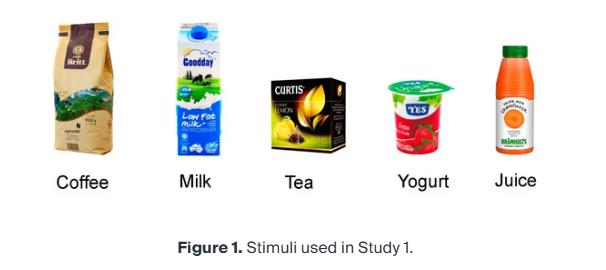
The neuromarketing methods included electroencephalogram (EEG), galvanic skin response (GSR) and eye-tracking to test the consumer’s cognitive responses, emotional arousal and attention to the packaging process respectively. The eye-tracking device was fixed on a computer screen in front of the participant. EEG and GSR devices were affixed. All three neuromarketing devices were used simultaneously. A declarative study was done after the neuromarketing methods to evaluate the participants’ preferences using a questionnaire.
The conclusion of Study 1 compares the differences between implicit measurements collected through neuromarketing techniques and explicit measurements through the declarative study. For the neuromarketing study, ANOVA was used to analyze EEG data. The researchers concluded that memory encoding showed statistically significant differences across the different products. They also found differences in the visual attention measured by the eye-tracking devices. Using ANOVA, they found significant differences in the time spent in areas of interest (AOI). Statistically significant differences were also found in the number of fixations.
Comparing this with the declarative study, statistically significant differences were found in the perceived complexity of different food packaging, particularly between milk, which was categorized as easy by participants, and all the other packaging. An inferential relationship between the variables was that there was a strong correlation between memorization and cognitive load, between appreciation and purchasing intent, and between time spent in AOI and number of fixations in AOI.
Study 2
Study 2 included 40 participants and nine different food products belonging to three categories: soft drinks (iced tea, soda and energy drinks), snacks (chips, nuts and nachos), and appetizers (cookies, chocolate bars and cereal bars).
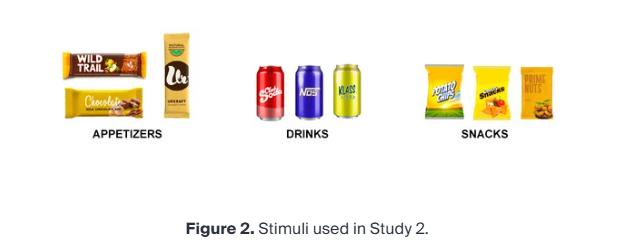
The same experimental design as in Study 1 was used.
The conclusion of Study 2 was that there were no significant differences in EEG and GSR metrics. The eye-tracking metrics yielded significant differences in visual attention, specifically in the number of fixations and the time spent exploring the packaging. Regarding an inferential relationship, a correlation was found between appreciation and purchase intent, and between time in AOI and number of fixations in AOI. Only in the snacks category was there a correlation between memorization and cognitive load. There were no statistically significant differences found between any variables from the declarative study.
Interpretation
From this study, I found that there can be differences between the results from neuromarketing methods and the declarative methods. The consumers’ self-reported preferences did not align with their implicit preferences. Related packaging research has also found that neurophysiological attention does not necessarily coincide with declarative preference, while an EEG preference-classification study reported only slight agreement between subjective and EEG-derived labels (García-Madariaga et al. [2]; Aldayel et al. [6]). This insight is a strong indicator that consumers’ decision-making processes are more unconscious and cannot be captured through a questionnaire alone. The neuromarketing results provided strong inferences into the emotional arousal, cognitive load, memory and visual attention of an individual.
It was also interesting to observe how EEG data did not yield strong conclusions through statistically significant measures. The authors provide a technical explanation for this. They argue that EEG is limited in that it can only capture events occurring in the cortical regions of the brain, while the emotional and psychological areas are in the subcortical regions, from where obtaining signals is difficult. A lack of stimulation from the packaging could be another reason.
These findings also illustrate the complexity of the data, and how measuring certain signals cannot reliably provide a strong indication of their perceived outputs. For example, differences in memory encoding do not always equate to differences in purchasing intent. Cognitive load could be due to strong visual complexity or overwhelming color spaces.
An interesting interpretation of this study is the differences between the results from Study 1 and Study 2. These differences could indicate that replicating the methods cannot provide strong replication of the results. This indicates a strong issue in the data collection process, since reliable result replication is a challenge. Results from the questionnaire also remained relatively varied across both studies, indicating a stronger presence of subconscious decision-making processes.
The statistically significant measures collected from eye-tracking devices indicate that eye-tracking could be a much more effective method for neuromarketing, as the results remained consistent across both studies. Other experiments show that front-of-pack labels, packaging transparency, product imagery and color can produce measurable differences in fixation, viewing time and purchase intention (Bix et al. [4]; Ma et al. [5]). It is also a much more affordable and portable method of collecting data. At the same time, the study highlights that relationships analyzed from visual aspects of packaging could be the result of visual complexity. Purchasing decisions could involve multiple biometric sensors, and hence, a single sensor could not encompass all of them. Recent multimodal work combining EEG and eye-tracking reinforces the value of integrating complementary signals rather than relying on a single measure (Usman et al. [7]).